Research Article | | Peer-Reviewed

Diagnostic Relevance of Prostate-Specific Antigen and Membrane Antigen Levels in Male Smokers and Nonsmokers in Port Harcourt, Nigeria

Received: 19 October 2026     Accepted: 2 November 2026     Published: 19 November 2026
Views:       Downloads:
Abstract

Prostate cancer remains a significant global public health concern, including in Nigeria, where increasing incidence and late- stage presentation have been reported in urban centres such as Port Harcourt. This study compared prostate-specific antigen (PSA) and prostate-specific membrane antigen (PSMA) levels among male smokers and non-smokers in Port Harcourt, Nigeria, to assess their diagnostic relevance and the influence of lifestyle factors. A comparative cross-sectional design was employed, involving 180 male participants aged 40–60 years: 90 smokers and 90 non-smokers recruited through convenience sampling. Data were collected using structured questionnaires covering demographic and lifestyle variables. We collected, processed, and analysed venous blood samples (5 mL) for PSA and PSMA levels using sandwich enzyme-linked immunosorbent assay (ELISA) techniques. Statistical analyses were performed using GraphPad Prism version 8.02. We compared groups using one-way ANOVA and post hoc tests, with statistical significance set at p < 0.05. We also performed receiver operating characteristic (ROC) curve analysis to evaluate diagnostic performance. The results showed that smokers had significantly higher mean PSA (4.48 ± 1.082 ng/mL) and PSMA (4.00 ± 1.628 ng/mL) levels than non- smokers (PSA: 1.98 ± 0.298 ng/mL; PSMA: 1.88 ± 0.145 ng/mL), with p- values of 0.0003 and < 0.0001, respectively. ROC analysis showed that PSMA had superior diagnostic performance (AUC = 0.766) than PSA (AUC = 0.634). Alcohol consumption was also significantly associated with elevated PSA and PSMA levels, whereas exercise had a significant but variable effect. Age influenced biomarker levels in specific groups, while smoking intensity and duration showed weak, non- significant correlations with both markers. In conclusion, smoking was associated with elevated prostate biomarkers, suggesting an increased risk of prostate dysfunction. PSMA showed greater diagnostic capability than PSA, suggesting it may be a more reliable biomarker for early detection. Integrating both biomarkers with lifestyle interventions may strengthen prostate cancer screening and prevention strategies.

Published in International Journal of Clinical and Experimental Medical Sciences (Volume 12, Issue 5)
DOI 10.11648/j.ijcems.20261205.12
Page(s) 96-102
Creative Commons

This is an Open Access article, distributed under the terms of the Creative Commons Attribution 4.0 International License (http://creativecommons.org/licenses/by/4.0/), which permits unrestricted use, distribution and reproduction in any medium or format, provided the original work is properly cited.

Copyright

Copyright © The Author(s), 2026. Published by Science Publishing Group

Keywords

PSA, PSMA, Prostate, Cigarettes, Smokers

1. Introduction
Prostate cancer is a major global health concern, including in Nigeria. Hospital records from cities such as Port Harcourt show rising incidence, with many patients diagnosed at advanced stages and experiencing poor survival. This highlights the need for prostate biomarkers and local screening programs . Biomarkers indicate a disease’s presence, severity, or progression and support screening, diagnosis, and prognosis. Two increasingly important biomarkers are Prostate-Specific Antigen (PSA) and Prostate-Specific Membrane Antigen (PSMA), each with distinct strengths and limitations .
Prostate-specific antigen (PSA) is a protein measured in the blood that has been used for decades to assist in detecting prostate enlargement and prostate cancer. Prostate epithelial cells secrete it. Although PSA testing is cost-effective and widely accessible, it lacks specificity, as PSA levels may also rise in benign conditions such as prostatitis and benign prostatic hyperplasia, potentially leading to false-positive findings and unnecessary biopsies . Prostate-specific membrane antigen (PSMA) is a protein expressed on the surface of prostate cancer cells, with expression increasing as the disease becomes more aggressive. It is generally regarded as more specific than PSA. In recent years, PSMA has gained importance not only as a laboratory marker but also as an imaging target, as demonstrated by Prostate-Specific Membrane Antigen–Positron Emission Tomography {PSMA-PET} scans, and as a target for therapeutic interventions. Because of its cancer specificity, PSMA is considered a promising complement to, or alternative to, PSA .
Smoking represents a significant lifestyle-related risk factor examined in prostate cancer research. Cigarette smoking is recognised as a source of carcinogen exposure and as a contributor to inflammation and oxidative stress. Although evidence concerning the association between smoking and an increased incidence of prostate cancer remains inconclusive, multiple studies indicate that smokers diagnosed with prostate cancer generally experience poorer prognoses, including more aggressive tumours, more advanced disease at diagnosis, and higher mortality rates .
In Nigeria, particularly in Port Harcourt, the capital of Rivers State, smoking among men is highly prevalent. Hospital reports indicate that many patients with prostate cancer present at advanced stages, frequently exhibiting markedly elevated PSA levels and high mortality rates. Despite these findings, published research comparing PSA and PSMA levels between smokers and non-smokers in the region remains limited .
Smoking may differentially affect the performance of prostate cancer biomarkers, underscoring the importance of comparing prostate-specific antigen (PSA) with prostate-specific membrane antigen (PSMA) among smokers. Clarifying these differences may enhance diagnostic accuracy and reduce the risks of misdiagnosis, delayed treatment, and unnecessary clinical procedures. This comparison provides evidence to help clinicians and public health policymakers select the most effective biomarker for prostate cancer screening and diagnosis .
Should PSMA prove to be a more reliable biomarker than PSA among smokers, these findings could support revisions to current prostate cancer screening protocols in Nigeria. Conversely, if cigarette smoking induces nonspecific elevations in both PSA and PSMA levels, revised diagnostic thresholds or combined biomarker testing may be needed to minimise false-positive results and improve diagnostic accuracy. Evidence from Port Harcourt could also inform screening guidelines for other urban populations across Nigeria with comparable characteristics .
This study has scientific and clinical significance. Scientifically, it may clarify biomarker expression among smokers. Clinically, it could support personalised screening, earlier diagnosis, and improved outcomes for men in similar settings. Prostate cancer is a major health burden in Nigeria, where late detection contributes to high mortality. Although prostate-specific antigen (PSA) testing is widely used, it is imperfect. Prostate-specific membrane antigen (PSMA) shows promise but remains under-investigated locally. Smoking may affect biomarker levels, yet little direct evidence from Port Harcourt or sub-Saharan Africa compares PSA and PSMA by smoking status. This study addresses that gap.
2. Materials and Methods
2.1. Research Design
The study adopted a cross-sectional comparative design. One hundred and eighty (180) participants aged between 40 and 60 years were included. Ninety participants were in the test group, and ninety were in the control group. The sample size was determined using Cochran’s standard formula for cross-sectional studies, based on current smoking prevalence in Nigeria .
2.2. Sample Collection and Processing
Five millilitres (5mL) of venous blood were drawn from each participant using sterile hypodermic syringes and needles and transported to the laboratory in an ice-packed cooler at 4°C. The blood samples were collected into plain bottles, centrifuged to separate the serum, and stored at -4°C until analysis. The analysis includes testing for prostate-specific antigen (PSA) and prostate-specific membrane antigen (PSMA).
2.3. Laboratory Analysis
2.3.1. Determination of PSA (ELISA Method)
Principle
PSA levels are typically estimated using the sandwich Enzyme-Linked Immunosorbent Assay (ELISA) technique. In this process, wells in a microtiter plate are coated with anti-PSA antibodies (capture antibodies). When the patient’s serum is added, any PSA present binds specifically to these antibodies. A second anti-PSA antibody, labelled with an enzyme such as horseradish peroxidase (HRP), is then introduced, creating an antibody–antigen–antibody sandwich complex. After washing to remove unbound material, add a chromogenic substrate such as TMB (tetramethylbenzidine). The enzyme transforms the substrate into a colour product, and the resulting colour intensity correlates directly with the PSA concentration in the sample.
2.3.2. Determination of PSMA (ELISA Method)
Principle
Prostate-Specific Membrane Antigen (PSMA) is measured using a sandwich ELISA method in which microtiter plate wells are pre-coated with PSMA-targeting antibodies. When standards or serum samples are added, the PSMA binds to these coated antibodies. Subsequently, a biotinylated detection antibody and HRP conjugate are introduced, forming an antibody–antigen–antibody sandwich complex. When TMB substrate is added, it changes colour in proportion to the PSMA concentration in the sample. Absorbance at 450 nm is then measured to determine concentration from the standard curve.
2.4. Statistical Analysis
The research data were analysed using GraphPad Prism version 8.2. Group comparisons will be conducted utilising one-way ANOVA and a subsequent Post Hoc test, with a significance level of p < 0.05. The findings will then be visually presented in ta.
3. Results
3.1. Demographic Information of Subjects
Table 1 presents the demographic characteristics of the study participants. The study recruited 180 subjects: 90 smokers (50%) in the test group and 90 non-smokers (50%) in the control group, showing an equal distribution between the two groups. Among the smokers, 55 (61.1%) reported consuming alcohol, while 35 (38.9%) did not, indicating that alcohol use was more prevalent among smokers. The age distribution showed that the largest proportions of smokers (44.4%) and non-smokers (38.9%) were in the 40–44-year age group, whereas the 60–64-year age group included the fewest participants in both groups. Among smokers, 58 (64.4%) reported engaging in regular exercise, while 32 (35.6%) reported no exercise.
3.2. Comparison of PSA and PSMA Levels in Test and Control Subjects
Table 2 compares the mean serum levels of Prostate-Specific Antigen (PSA) and Prostate-Specific Membrane Antigen (PSMA) between smokers and non-smokers. Smokers exhibited significantly higher mean PSA levels (4.48 ± 6.082 ng/ml) than non-smokers (1.98 ± 2.298 ng/ml). Likewise, mean PSMA concentration was substantially higher in smokers (4.00 ± 2.628 ng/ml) than in non-smokers (1.88 ± 1.845 ng/ml). These differences were statistically significant (PSA, p = 0.0003; PSMA, p < 0.0001).
Table 1. Demographic Information of Subjects.

Groups

Number of Subjects

Total Subjects

180

Non-Smokers (Control)

90 (50%)

Smokers (Test)

90 (50%)

Non-Alcohol Users

35 (38.9%)

Alcohol Users

55 (61.1%)

Age Grouping

Smokers

Non-Smokers

40 - 44 Years

40 (44.4%)

35 (38.9%)

45 - 49 Years

16 (17.8%)

24 (26.7%)

50 - 54 Years

15 (16.7%)

16 (17.8%)

55 - 59 Years

14 (15.6%)

9 (10.0%)

60 - 64 Years

5 (5.5%) 90 (100%)

6 (6.6%) 90 (100%)

Physical Activity

No Exercise

32 (35.6%)

Exercise

58 (64.4%)

Table 2. Comparison of PSA and PSMA Levels in Test and Control Subjects.

Parameter/Groups

PSA (ng/ml)

PSMA (ng/ml)

Control (N = 90)

1.98 ± 0.298

1.88 ± 0.145

Test (N = 90)

4.48 ± 1.082

4.00 ± 1.628

P-value

0.0003

<0.0001

Remark

S

S

PSA: Prostate-Specific Antigen, PSMA: Prostate-Specific Membrane Antigen, S: Significant.
3.3. Receiver Operating Characteristic Curve of PSA and PSMA
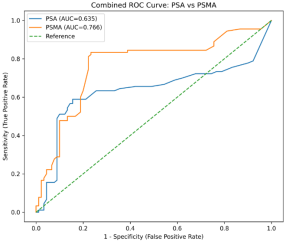
Table 3 and Figure 1 present the receiver operating characteristic (ROC) analysis assessing the diagnostic performance of PSA and PSMA in distinguishing smokers from non-smokers. PSA had an area under the curve (AUC) of 0.634, indicating fair discriminatory ability, whereas PSMA had a higher AUC of 0.766, demonstrating stronger differentiation between the two groups. Both biomarkers exhibited statistically significant diagnostic performance (PSA: p = 0.0018; PSMA: p < 0.0001). The lower standard error for PSMA (0.0373), compared with PSA (0.044), further suggests greater precision in its diagnostic accuracy.
Table 3. Receiver Operating Characteristic Curve: PSA and PSMA.

Area under the ROC curve

PSA

PSMA

Area

0.634

0.766

Std. Error

0.044

0.0373

P value

0.0018

<0.0001

Figure 1. Combined ROC Curve for PSA and PSMA.
4. Discussion and Conclusion
4.1. Discussion
This study compared prostate-specific antigen (PSA) and prostate-specific membrane antigen (PSMA) levels between male smokers and non-smokers in Port Harcourt, with a focus on the effects of cigarette smoking on prostate-related biomarkers. Most participants were middle-aged, primarily in their 40s and 50s. This age group is significant because physiological and pathological changes in the prostate, including benign prostatic hyperplasia, inflammation, and early neoplastic changes, often begin to emerge in middle age. Previous research has demonstrated that the evaluation of prostate biomarkers becomes increasingly important in men over 40 due to age-related changes in the prostate gland . These findings reinforce the established understanding that middle age is a critical period for prostate screening and biomarker assessment.
The findings of the present study demonstrate that the participants’ demographic characteristics provided a balanced framework for evaluating the effects of cigarette smoking on prostate-related biomarkers. The equal representation of smokers (50%) and non-smokers (50%) minimised selection bias and strengthened the validity of comparisons between the two groups. The predominance of participants in the 40–44-year age group is consistent with epidemiological reports indicating that smoking-related metabolic and inflammatory changes begin to manifest in middle adulthood, a period during which prostate health monitoring becomes increasingly important . The higher prevalence of alcohol consumption among smokers (61.1%) also aligns with previous reports that cigarette smoking and alcohol consumption frequently co-occur because they share behavioural, psychosocial, and neurobiological determinants . This co-occurrence is significant because alcohol may act synergistically with tobacco smoke to increase oxidative stress, inflammation, and cellular injury.
The demographic characteristics observed in this study are comparable to those reported in , which found that smoking is more prevalent among middle-aged men and is often associated with unhealthy lifestyle behaviours, such as alcohol consumption. Similarly, reported that tobacco users are significantly more likely to consume alcohol than non-smokers. However, some studies have reported different demographic patterns. For example, observed a higher prevalence of smoking among adults aged over 60 years in certain developed countries, reflecting differences in population age structure, smoking cessation programmes, and access to healthcare. These disparities underscore that smokers' demographic characteristics may vary across geographical regions, socioeconomic conditions, and public health interventions.
A major finding of this study is that smokers had significantly higher serum PSA and PSMA concentrations than nonsmokers. These findings suggest that cigarette smoking is associated with increased expression of prostate-related biomarkers, potentially through chronic inflammation, oxidative stress, endothelial dysfunction, and DNA damage caused by tobacco constituents. Cigarette smoke contains numerous carcinogens, including polycyclic aromatic hydrocarbons, nitrosamines, cadmium, and reactive oxygen species, which may promote cellular injury and inflammatory responses in prostate tissue, thereby increasing PSA release and PSMA expression . Elevated PSMA expression may also reflect increased cellular proliferation and angiogenesis, as PSMA is highly expressed in prostate epithelial cells undergoing malignant transformation .
The observation of significantly elevated PSA levels among smokers is consistent with several previous investigations. reported that smoking was associated with increased PSA concentrations, particularly among long-term smokers, suggesting that smoking may induce chronic prostatic inflammation. Similarly, found that cigarette smoking was associated with more aggressive prostate disease and poorer clinical outcomes, indicating that tobacco exposure may influence both prostate biology and disease progression. More recently, concluded that smoking contributes to prostate cancer progression through inflammatory and epigenetic mechanisms, which may partly explain the higher PSA concentrations observed among smokers. These studies support the present findings that smoking adversely affects prostate health and influences serum biomarkers.
The present findings are also consistent with recent studies demonstrating increased PSMA expression in individuals with prostate pathology. reported that PSMA expression increases progressively with prostate disease severity and has become an important molecular target for prostate cancer imaging and therapy. Similarly, showed that PSMA-based imaging detects prostate lesions more sensitively than conventional imaging modalities. Although the present study evaluated apparently healthy smokers rather than patients with prostate cancer, the significantly higher PSMA concentrations among smokers may indicate that tobacco exposure induces early biological changes in prostate tissue before overt malignancy develops. This observation supports the growing interest in PSMA as an early biomarker of prostate abnormalities.
However, not all previous studies agree with these findings . A meta-analysis assessing the association between smoking and prostate cancer risk reported inconsistent relationships between cigarette smoking and PSA concentrations. These findings suggest that smoking may not directly increase PSA levels but may instead influence disease progression after cancer develops. Similarly, found no significant association between smoking status and baseline PSA concentrations after adjustment for age, body mass index, and other confounding variables. Differences between these studies and the present findings may be attributable to variations in study populations, smoking intensity, duration of tobacco exposure, ethnicity, laboratory methods, sample size, and adjustment for confounding variables. In addition, genetic susceptibility and environmental factors may modify the biological response to cigarette smoke.
Receiver Operating Characteristic (ROC) analysis further supports the findings of the present study, demonstrating that PSMA has greater discriminatory ability than PSA in distinguishing smokers from non-smokers. The higher Area Under the Curve (AUC = 0.766) observed for PSMA, compared with PSA (AUC = 0.634), indicates superior diagnostic performance and suggests that PSMA may be a more sensitive biomarker for detecting smoking-related prostate changes. This finding is consistent with , who demonstrated excellent diagnostic accuracy of PSMA-targeted imaging in identifying clinically significant prostate lesions, and with , who reported greater sensitivity for PSMA-based diagnostic approaches than for conventional PSA measurements alone. The relatively lower diagnostic accuracy of PSA in the present study aligns with previous reports that PSA lacks specificity, as it can also be elevated in benign prostatic hyperplasia, prostatitis, urinary tract infections, and other non-malignant conditions .
4.2. Conclusion
This study indicates that cigarette smoking is associated with elevated PSA and PSMA levels among male participants in Port Harcourt, suggesting that smoking may contribute to prostatic cellular stress, inflammation, and early pathological changes. PSMA demonstrates greater discriminatory and diagnostic capabilities than PSA, suggesting that it may serve as a more reliable biomarker for smoking-related prostate conditions. Age and alcohol consumption significantly influence biomarker levels, while exercise may cause a temporary increase, underscoring the importance of physiological and lifestyle factors when interpreting these biomarkers. Conversely, smoking intensity (cigarettes per day) and duration show weak, non-significant associations with PSA and PSMA, suggesting that individual biological differences and other confounders may influence these biomarkers more than cumulative exposure. Overall, the findings identify PSMA as a more sensitive indicator of prostatic changes than PSA and support integrating lifestyle modifications, particularly smoking cessation, with routine prostate screening for middle-aged men to promote early detection and prevention.
Abbreviations

PSA

Prostate-specific Antigen

PSMA

Prostate-specific Membrane Antigen

ELISA

Enzyme-linked Immunosorbent Assay

ROC

Receiver Operating Characteristic

AUC

Area Under the Curve

TMB

Tetramethylbenzidine

HRP

Horseradish Peroxidase

PSMA-PET

Prostate-Specific Membrane Antigen–Positron Emission Tomography

Author Contributions
Osiagor Josephine: Funding acquisition, Writing – original draft
Wariboko Anthony Hellen: Methodology, Project administration, Validation
Brown Holy: Supervision, Writing – review & editing, Conceptualisation
Conflicts of Interest
The authors declare no conflicts of interest.
References
[1] Tolani, M. A., Agbo, C. A., Paciorek, A., Umar, S. S., & Ojewola, R. W. (2024). Detection and management of localised prostate cancer in Nigeria: Barriers and facilitators according to patients, caregivers and healthcare providers. BMC Health Services Research, 24, 918.
[2] Parsi, M. A., Jones, J. S., & Klein, E. A. (2021). Prostate-specific antigen and newer biomarkers in prostate cancer screening and diagnosis. Urologic Clinics of North America, 48(1), 1–12.
[3] Al Saffar, H., Mari, A., & Tayara, M. (2024). Emerging role of prostate-specific membrane antigen in early prostate cancer diagnosis and risk stratification. Cancers, 16(4), 912.
[4] Bouchelouche, K., Choyke, P. L., & Capala, J. (2018). Prostate-specific membrane antigen as a target for imaging and therapy. American Journal of Nuclear Medicine and Molecular Imaging, 8(3), 220–234.
[5] Burden, E., Issues, I., & Prospects, P. (2023). Burden, issues and prospects of prostate cancer in Nigeria. African Journal of Urology, 29(1), 44–52.
[6] Olorunniyi, S. B., & Ogo, C. N. (2025). Predictors of late diagnosis of prostate cancer among men of African ancestry receiving care at a urology clinic in Nigeria. ecancermedicalscience, 19, 1917.
[7] Harmatz, E. S., Goldberg, H., Del Giudice, F., & Zlotta, A. R. (2024). Biomarker comparison and screening strategies in prostate cancer diagnosis. European Urology Oncology, 7(1), 11–20.
[8] Adeloye, D., David, R. A., Aderemi, A. V., Iseolorunk anmi, A., Oyedokun, A., Iweala, E. E. J., & Omoregbe, N. (2019). An estimate of the incidence of prostate cancer in Africa: A systematic review and me ta-analysis. PLOS ONE, 14(4), e0215588.
[9] Szymańska, A., Procyk, D., Oleksyszyn, J., & Sieńczyk, M. (2019). Development and evaluation of an immunoglobulin Y-based ELISA for measuring prostate-specific antigen in human serum. Annals of Laboratory Medicine, 39(4), 373–380.
[10] Murphy, G. P., Elgamal, A. A., Su, S. L., Bostwick, D. G., & Holmes, E. H. (1998). Measurement of serum prostate-specific membrane antigen, a new prognostic marker for prostate cancer. Urology, 51(5 Suppl. 1), 89–97.
[11] Loeb, S., Vellekoop, A., Ahmed, H. U., Catto, J., Emberton, M., Nam, R., & Rosario, D. J. (2014). Systematic review of complications of prostate biopsy. European Urology, 66(6), 978–983.
[12] Mottet, N., van den Bergh, R. C. N., Briers, E., et al. (2024). EAU guidelines on prostate cancer. European Association of Urology Guidelines.
[13] Sung, H., Ferlay, J., Siegel, R. L., Laversanne, M., Soerjomataram, I., Jemal, A., & Bray, F. (2021). Global cancer statistics 2020: GLOBOCAN estimates of incidence and mortality worldwide for 36 cancers in 185 countries. CA: A Cancer Journal for Clinicians, 71(3), 209–249.
[14] Rebbeck, T. R. (2022). Prostate cancer genetics and disparities in risk and outcomes. Annual Review of Genomics and Human Genetics, 23, 357–381.
[15] World Health Organisation. (2024). WHO report on the global tobacco epidemic 2024. World Health Organisation.
[16] GBD 2021 Tobacco Collaborators. (2024). Spatial, temporal, and demographic patterns in the global burden of tobacco use, 1990–2021. The Lancet Public Health, 9(5), e343–e356.
[17] Tobacco Collaborators. (2024). Spatial, temporal, and demographic patterns in the global burden of tobacco use, 1990–2021. The Lancet Public Health, 9(5), e343–e356.
[18] Islami, F., Goding Sauer, A., Miller, K. D. (2022). Proportion and number of cancer cases attributable to potentially modifiable risk factors. CA: A Cancer Journal for Clinicians, 72(6), 553–578.
[19] Hecht, S. S. (2012). Tobacco smoke carcinogens and the pathogenesis of smoking-related cancer. Nature Reviews Cancer, 12(9), 592–604.
[20] Silver, D. A., Pellicer, I., Fair, W. R., Heston, W. D. W., & Cordon-Cardo, C. (2021). Prostate-specific membrane antigen expression in normal and malignant human tissues: Clinical implications. Clinical Cancer Research, 27(18), 5056–5064.
[21] Platz, E. A., Rimm, E. B., Willett, W. C., Kantoff, P. W., Giovannucci, E., & Stampfer, M. J. (2001). Cigarette smoking, plasma antioxidants, and prostate-specific antigen concentrations. Cancer Epidemiology, Biomarkers & Prevention, 10(7), 729–733.
[22] Kenfield, S. A., Stampfer, M. J., Chan, J. M., & Giovannucci, E. (2011). Smoking and prostate cancer survival and recurrence. JAMA, 305(24), 2548–2555.
[23] Hofman, M. S., Lawrentschuk, N., Francis, R. J. (2020). Prostate-specific membrane antigen PET-CT in patients with high-risk prostate cancer before curative-intent surgery or radiotherapy (proPSMA): A prospective, randomised, multicentre study. The Lancet, 395(10231), 1208–1216.
[24] Huncharek, M., Haddock, K. S., Reid, R., & Kupelnick, B. (2010). Smoking as a risk factor for prostate cancer: A meta-analysis of 24 prospective cohort studies. American Journal of Public Health, 100(4), 693–701.
[25] Rodríguez, C., Freedland, S. J., Deka, A., (2019). Smoking intensity and prostate-specific antigen concentrations in adult men. Prostate Cancer and Prostatic Diseases, 22(2), 250–257.
[26] Perera, M., Papa, N., Roberts, M., Williams, M., Udovicich, C., Vela, I., Christidis, D., Bolton, D., Hofman, M. S., & Murphy, D. G. (2020). Gallium-68 prostate-specific membrane antigen positron emission tomography in advanced prostate cancer: Updated diagnostic accuracy. European Urology, 77(4), 403–417.
Cite This Article
  • APA Style

    Josephine, O., Hellen, W. A., Holy, B. (2026). Diagnostic Relevance of Prostate-Specific Antigen and Membrane Antigen Levels in Male Smokers and Nonsmokers in Port Harcourt, Nigeria. International Journal of Clinical and Experimental Medical Sciences, 12(5), 96-102. https://doi.org/10.11648/j.ijcems.20261205.12

    Copy | Download

    ACS Style

    Josephine, O.; Hellen, W. A.; Holy, B. Diagnostic Relevance of Prostate-Specific Antigen and Membrane Antigen Levels in Male Smokers and Nonsmokers in Port Harcourt, Nigeria. Int. J. Clin. Exp. Med. Sci. 2026, 12(5), 96-102. doi: 10.11648/j.ijcems.20261205.12

    Copy | Download

    AMA Style

    Josephine O, Hellen WA, Holy B. Diagnostic Relevance of Prostate-Specific Antigen and Membrane Antigen Levels in Male Smokers and Nonsmokers in Port Harcourt, Nigeria. Int J Clin Exp Med Sci. 2026;12(5):96-102. doi: 10.11648/j.ijcems.20261205.12

    Copy | Download

  • @article{10.11648/j.ijcems.20261205.12,
      author = {Osiagor Josephine and Wariboko Anthony Hellen and Brown Holy},
      title = {Diagnostic Relevance of Prostate-Specific Antigen and Membrane Antigen Levels in Male Smokers and Nonsmokers in Port Harcourt, Nigeria},
      journal = {International Journal of Clinical and Experimental Medical Sciences},
      volume = {12},
      number = {5},
      pages = {96-102},
      doi = {10.11648/j.ijcems.20261205.12},
      url = {https://doi.org/10.11648/j.ijcems.20261205.12},
      eprint = {https://article.sciencepublishinggroup.com/pdf/10.11648.j.ijcems.20261205.12},
      abstract = {Prostate cancer remains a significant global public health concern, including in Nigeria, where increasing incidence and late- stage presentation have been reported in urban centres such as Port Harcourt. This study compared prostate-specific antigen (PSA) and prostate-specific membrane antigen (PSMA) levels among male smokers and non-smokers in Port Harcourt, Nigeria, to assess their diagnostic relevance and the influence of lifestyle factors. A comparative cross-sectional design was employed, involving 180 male participants aged 40–60 years: 90 smokers and 90 non-smokers recruited through convenience sampling. Data were collected using structured questionnaires covering demographic and lifestyle variables. We collected, processed, and analysed venous blood samples (5 mL) for PSA and PSMA levels using sandwich enzyme-linked immunosorbent assay (ELISA) techniques. Statistical analyses were performed using GraphPad Prism version 8.02. We compared groups using one-way ANOVA and post hoc tests, with statistical significance set at p < 0.05. We also performed receiver operating characteristic (ROC) curve analysis to evaluate diagnostic performance. The results showed that smokers had significantly higher mean PSA (4.48 ± 1.082 ng/mL) and PSMA (4.00 ± 1.628 ng/mL) levels than non- smokers (PSA: 1.98 ± 0.298 ng/mL; PSMA: 1.88 ± 0.145 ng/mL), with p- values of 0.0003 and < 0.0001, respectively. ROC analysis showed that PSMA had superior diagnostic performance (AUC = 0.766) than PSA (AUC = 0.634). Alcohol consumption was also significantly associated with elevated PSA and PSMA levels, whereas exercise had a significant but variable effect. Age influenced biomarker levels in specific groups, while smoking intensity and duration showed weak, non- significant correlations with both markers. In conclusion, smoking was associated with elevated prostate biomarkers, suggesting an increased risk of prostate dysfunction. PSMA showed greater diagnostic capability than PSA, suggesting it may be a more reliable biomarker for early detection. Integrating both biomarkers with lifestyle interventions may strengthen prostate cancer screening and prevention strategies.},
     year = {2026}
    }
    

    Copy | Download

  • TY  - JOUR
    T1  - Diagnostic Relevance of Prostate-Specific Antigen and Membrane Antigen Levels in Male Smokers and Nonsmokers in Port Harcourt, Nigeria
    AU  - Osiagor Josephine
    AU  - Wariboko Anthony Hellen
    AU  - Brown Holy
    Y1  - 2026/11/19
    PY  - 2026
    N1  - https://doi.org/10.11648/j.ijcems.20261205.12
    DO  - 10.11648/j.ijcems.20261205.12
    T2  - International Journal of Clinical and Experimental Medical Sciences
    JF  - International Journal of Clinical and Experimental Medical Sciences
    JO  - International Journal of Clinical and Experimental Medical Sciences
    SP  - 96
    EP  - 102
    PB  - Science Publishing Group
    SN  - 2469-8032
    UR  - https://doi.org/10.11648/j.ijcems.20261205.12
    AB  - Prostate cancer remains a significant global public health concern, including in Nigeria, where increasing incidence and late- stage presentation have been reported in urban centres such as Port Harcourt. This study compared prostate-specific antigen (PSA) and prostate-specific membrane antigen (PSMA) levels among male smokers and non-smokers in Port Harcourt, Nigeria, to assess their diagnostic relevance and the influence of lifestyle factors. A comparative cross-sectional design was employed, involving 180 male participants aged 40–60 years: 90 smokers and 90 non-smokers recruited through convenience sampling. Data were collected using structured questionnaires covering demographic and lifestyle variables. We collected, processed, and analysed venous blood samples (5 mL) for PSA and PSMA levels using sandwich enzyme-linked immunosorbent assay (ELISA) techniques. Statistical analyses were performed using GraphPad Prism version 8.02. We compared groups using one-way ANOVA and post hoc tests, with statistical significance set at p < 0.05. We also performed receiver operating characteristic (ROC) curve analysis to evaluate diagnostic performance. The results showed that smokers had significantly higher mean PSA (4.48 ± 1.082 ng/mL) and PSMA (4.00 ± 1.628 ng/mL) levels than non- smokers (PSA: 1.98 ± 0.298 ng/mL; PSMA: 1.88 ± 0.145 ng/mL), with p- values of 0.0003 and < 0.0001, respectively. ROC analysis showed that PSMA had superior diagnostic performance (AUC = 0.766) than PSA (AUC = 0.634). Alcohol consumption was also significantly associated with elevated PSA and PSMA levels, whereas exercise had a significant but variable effect. Age influenced biomarker levels in specific groups, while smoking intensity and duration showed weak, non- significant correlations with both markers. In conclusion, smoking was associated with elevated prostate biomarkers, suggesting an increased risk of prostate dysfunction. PSMA showed greater diagnostic capability than PSA, suggesting it may be a more reliable biomarker for early detection. Integrating both biomarkers with lifestyle interventions may strengthen prostate cancer screening and prevention strategies.
    VL  - 12
    IS  - 5
    ER  - 

    Copy | Download

Author Information
  • Abstract
  • Keywords
  • Document Sections

    1. 1. Introduction
    2. 2. Materials and Methods
    3. 3. Results
    4. 4. Discussion and Conclusion
    Show Full Outline
  • Abbreviations
  • Author Contributions
  • Conflicts of Interest
  • References
  • Cite This Article
  • Author Information